Media
Conversations and films, catalogs, texts about the work and press.
Exhibition film · Köppe Contemporary, Berlin · 2025
PURE ROMYA tour of the exhibition
The solo exhibition PURE ROMY at Köppe Contemporary, Berlin-Grunewald, May to August 2025. Curated by André Lindhorst.
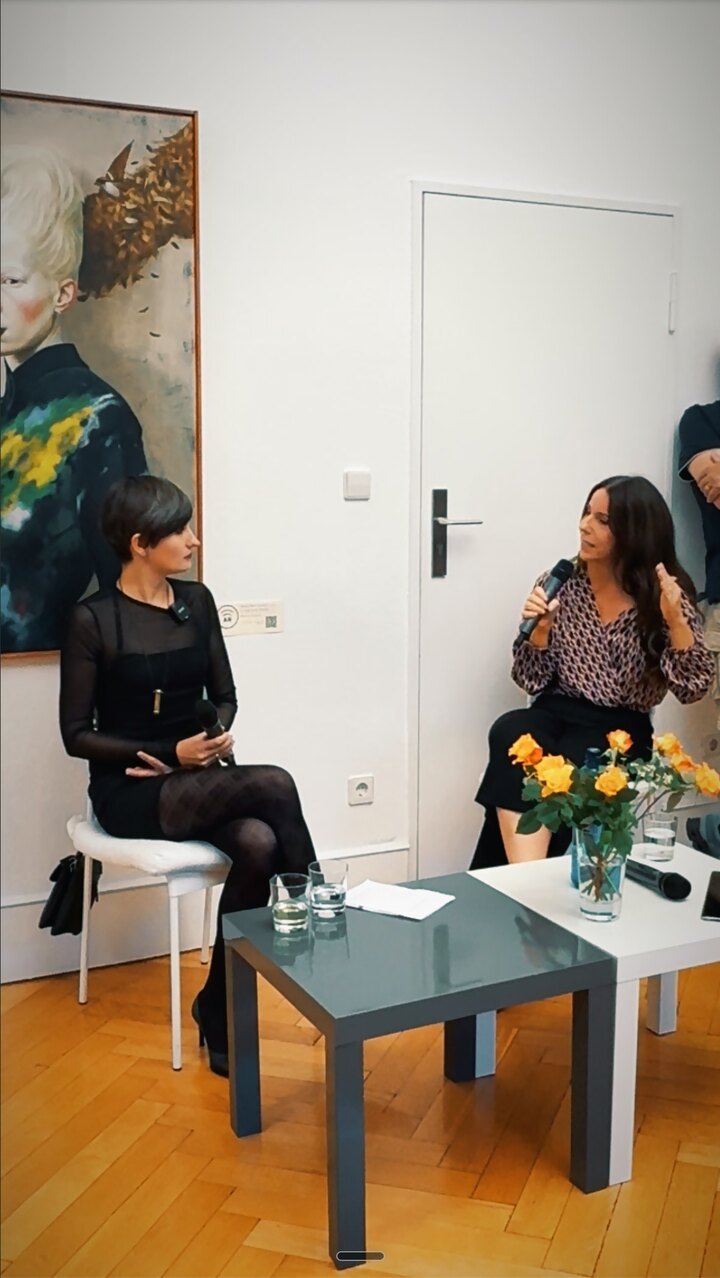
Artist talk · Köppe Contemporary, Berlin · August 16, 2025 · 46 minutes
Maria Wirth in conversation with ROMY
At the closing summer fest of PURE ROMY, Maria Wirth – curator and gallerist at feinart berlin – talked with ROMY about Old Master oil painting and glazing, about faces that are not portraits, about feathers as a motif, about augmented reality and about working with AI in the sketching process. With questions from the audience. In German, with English subtitles (gear icon › Subtitles › English).
Show chaptersHide chapters13 chapters · 0:00 to 42:56
- Welcome and the title “PURE ROMY”
- From portrait to scene: the space around the figures
- “Is that Tilda Swinton?” Models and references
- Not portraits: allegory, self-portrait, a life in paintings
- Old Master oil painting, self-taught
- How a painting is made: ground, grisaille, glazing
- Why the elaborate path?
- Feathers, cocoon, collective memory
- Augmented reality: taking the story further
- AI in art: process, assessment, 130 machines
- Outlook: sound in the exhibition space
- Closing words
- Audience questions: Neo Rauch, dream and reality
Works mentioned: Aurorae · Aufbruch · Feminautin · Übergangszone · Eva & Eva · Sturmhorchende · Manopause · Kokon · Traumnest · Wellenreiter
The video is hosted on YouTube and only loads when you click.
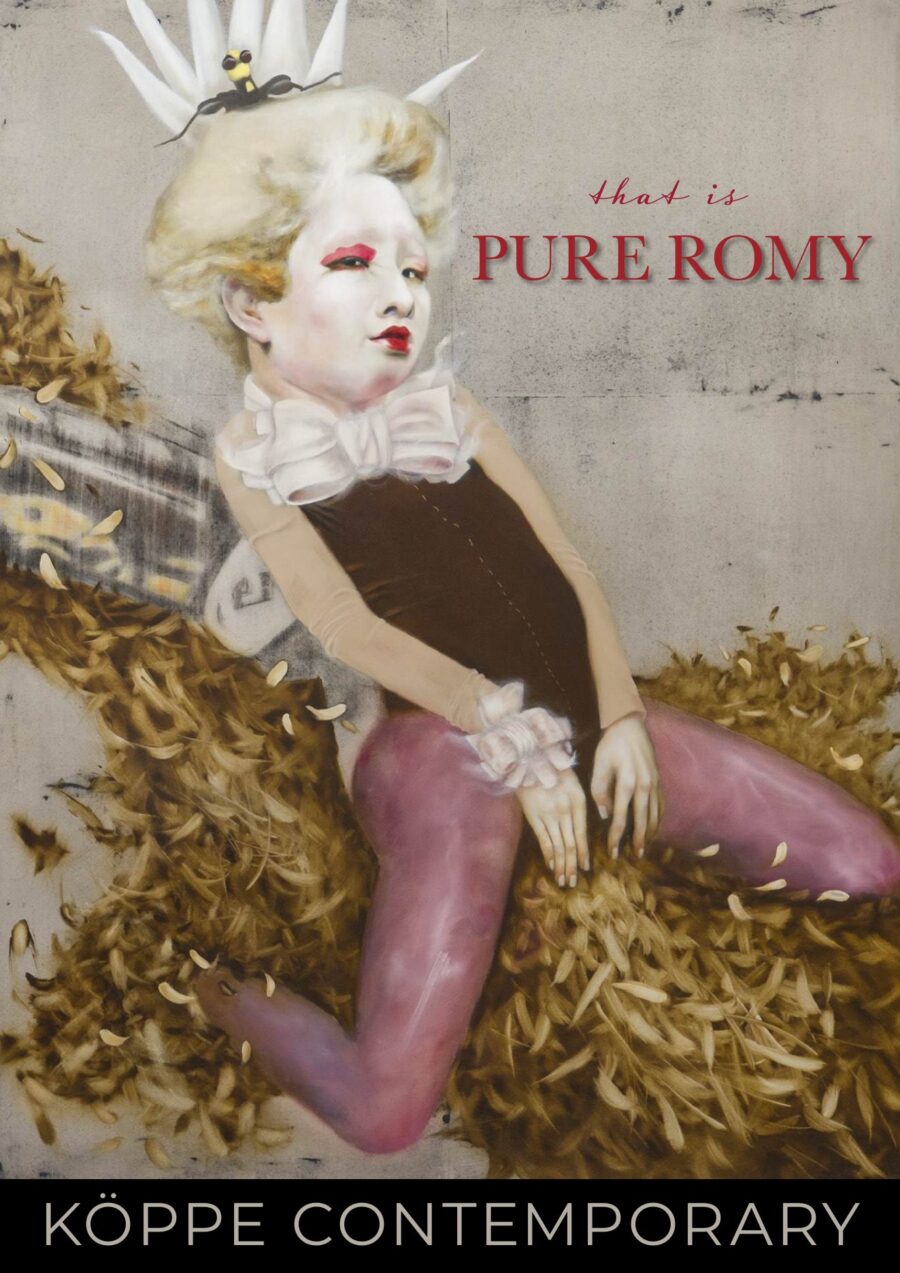
Catalog · Köppe Contemporary, Berlin 2025
PURE ROMY
50 pages with the works of the exhibition and texts by Prof. Alberto D’Atanasio and André Lindhorst. To browse online or as a PDF.
Browse the catalogDownload PDF · 7 MB
More films
From earlier exhibitions and conversations. New films from the studio appear regularly on Instagram: @kunstromy
Exhibition film · 2019
ROMY – BEYOND NOW
Solo exhibition, Köppe Contemporary, Berlin
Artist talk · July 8, 2025
Annette Schneider (ART BREAKERS) in conversation with ROMY
Köppe Contemporary, Berlin
Texts about the work
Three texts that describe ROMY’s painting from the outside.
The Face of the Soul
Prof. Alberto D’Atanasio
Professor of Art History and Semiotics of Nonverbal Languages
PURE ROMY catalog, 2025
Reading time 4 minutes
“Romy is a gateway to an elsewhere.”
There are two key terms essential to understanding this artist: revelation and disclosure. The first belongs to the object as it presents itself to the viewer; the second comes from the gaze of the observer toward what is being seen. This is how I would like to introduce the artistic practice of Romy Campe.
In her paintings, she reveals and discloses figures that emerge through a refined exploration of line, drawing, and chromatic nuance. She does not choose her subjects randomly, nor does she paint impulsively – each work is an inspired composition. Her artistic process merges meditation and contemplation: she meditates while composing the work, choosing the subject and positioning it within the pictorial space; she contemplates when the work looks back at her, when it irradiates the subject with a light that is not of this world.
She creates that very light that once distinguished Leonardo da Vinci, Mantegna, and Caravaggio. The light she invents is true revelation – it defines her artistic signature, the essence of her being: woman, girl, and still a child, ever capable of wonder.
This artist is like a shaman – over time she has gained the freedom of someone who can sense the infinite and the transcendent. Romy is a gateway to an elsewhere.
She paints as if in ritual, in a celebratory act. Her figures seem shaped from light, as though matter were only a vessel preserving something transcendent. Like a Renaissance painter, she attends meticulously to every detail. Nothing is accidental, nothing is the result of spontaneous creativity – everything is part of a narrative. And in that narrative, a wind becomes visible, made perceptible through her painting.
Her visual world is laced with symbols and figures – still, yet dynamic. In some works, using a subtractive technique, she creates a turbulence of monochrome tonalities, as if her magic had suspended the subject in time, capturing its enchantment. The viewer stands before a moment held in place, transformed into memory through the figurative image.
In her “Roms” – hybrid pictorial bodies – she invents collages with an anthropomorphic presence reminiscent of Salvador Dalí’s hyperrealism. It is as though archetypes from our collective memory have become new symbols, gazing at us and allowing themselves to be seen.
Her tonal planes create space and structure – like the reliefs of Donatello, where even the deepest background carries incision. Thus a continuum is formed between the empirical space of the observer and the imaginary space of the artwork.
To her, the canvas also becomes a symbol of divine creation: a space where, through the ruach – the breath – form becomes person, angelic, like the Creator. She is deeply conscious of this. Like Vincent van Gogh, she possesses a passionate temperament, capable of being deeply moved and enchanted like an eternal child. And like Van Gogh, she has an endless love for portraits that seem born of fable.
In each human figure, nature and matter become thresholds – her subjects reveal their belonging to the Creator. This is why she is a truly magical woman, a shaman in every sense. Fittingly, she sometimes paints barefoot, like the sorceresses in John William Waterhouse’s The Magic Circle (1886).
Romy Campe possesses a meticulous and masterful technique. Her works are constructed through a precise orchestration of forms in relation to color and light. In her art, the structure of the composition itself becomes the source of contemplation. Light becomes an atmosphere – mysterious and open to the viewer’s gaze.
The gazes of her figures bear something singular – a timelessness, evoking subtle movements of the soul. They are anchored in a different yet parallel realm – similar to, yet distinct from, that of the viewer. The human figure becomes, in her hands, an epiphany of a truth grasped and shaped by human cognition.
It is remarkable to watch her paint – she seems to dance, to perform a rite. Her artistic gesture carries the force of a cathartic act. What Romy seeks is that ancient wonder awakened by the exercise of mimesis: matter and nature are subject to the passage of time, and it is the artist who renders them eternal, immortal, infinite.
Romy Campe does not paint enigmatic subjects locked in silence – rather, she unveils the mystery of matter, which holds within it the spark of the infinite. She seeks to reveal and disclose all of this. Through her art, she gives form to the infinite – and a face to the soul.
Pure Romy
André Lindhorst, curator of the exhibition
PURE ROMY catalog, 2025
Reading time 1 minute
“Her central subject is the human being. ROMY’s art explores themes such as figuration and corporeality.”
The Berlin-based painter, draughtswoman, and object artist Romy Campe is known in the art world simply as ROMY. Within figurative painting – especially portraiture and the human image – she occupies a distinctive position. Her work is inspired by the traditional layering techniques of great portrait masters like Rembrandt, Vermeer, Frans Hals, or Caravaggio. Her oil paintings, created through countless finely glazed layers, radiate an aura of old mastery.
Her central subject is the human being. ROMY’s art explores themes such as figuration and corporeality. In this exhibition, “PURE ROMY”, she presents portraits of women, men, and children – mostly as solo figures – that are at times sensual and intimate, at times androgynous, ambiguous, and shrouded in mystery.
The exhibition shows how ROMY has expanded her artistic practice through experimentation and digital engagement. She often integrates fantastical, surreal, or symbolist elements into her figurations.
Her figures seem to assume a fictional identity and physical presence, as if they were stepping out of the canvas and into space. Hybrids, mythic beings, symbioses, and metamorphoses are central to her visual language. Across her paintings, drawings, collage works, objects, and installations, she draws from worlds of myth, fairy tale, and dream.
Many of her current works evoke a sense of being in between – a zone where time dissolves, and distinctions between past, present, and future blur. This also applies to recurring sculptural motifs like the cocoon or the nest, which revolve around connection, emergence, and release.
Another key element of the exhibition is the ROMS – mixed-media painting collages in which digital editing introduces movement that becomes visible through a tablet or smartphone.
Empathy Made Image
André Lindhorst, curator at Köppe Contemporary, former director of Kunsthalle Osnabrück
BEYOND NOW catalog, 2019
Reading time 3 minutes
“The image of the human being has become more questionable and unpredictable than ever.”
The human being plays the central role in Romy Campe’s work. The artist’s portraits reflect human traits – inner states, moods and frames of mind. Even though her motifs also bear features of the fantastic and the surreal, all of this points to the early modern tradition of the psychological image of the human being. Some motifs thus call to mind great painting traditions (Caravaggio, Frans Hals, Rembrandt).
The artist’s grisaille oil technique is likewise rooted in Old Master methods. In the course of painting she lays up to forty layers of glaze one over another. That ROMY blends surreal and fantastic dimensions into this Old Master idiom, however, lends her compositions a particularly idiosyncratic and individual note.
What she paints are imagined worlds on the border between reality and dream, between faithful likeness and whimsical creation. A particular expression of the eyes, along with the bearing and gestures of the people she portrays, points to inner states. Such motifs reflect feelings about life and emotions – longing, expectation, hope or confidence, but also fear, anger or despair.
The artist often develops her motifs from her own self-image. Alongside depictions of modern, mostly young women from everyday life, her œuvre is populated by fantastic figures, hybrid and fabulous creatures and mythological beings. Symbioses and transformations are omnipresent.
A dominant aspect of many of ROMY’s works is the background, often kept in muted colors and mostly deep and dark, against which her figures act. It is connected with the effect of sfumato (the blurred or indeterminate). This stylizing or fading out of any tangible space underlines the impression of an imagined, fantastic in-between zone in which it is no longer possible to distinguish between reality and dream, nor between today, yesterday and tomorrow.
“My paintings depict visions of human existence and encompass realms of imagination, desire, dreaming, and escape from the present,” ROMY once explained in an interview. Despite the dreamlike ambiguity in which the artist “embeds” many of her motifs, her paintings also evoke associations with our modern present and the unsettling experiences that come with it.
Themes such as melancholy or the search for one’s own identity are therefore as present in the artist’s motifs as a spirit of resistance. In ROMY’s paintings the ram becomes a mythical symbol. With its curved horns, its strength and its courage, it stands for assertiveness and for resistance against everything that presses in on it.
Collages hold a special place in the artist’s œuvre. On the one hand, these are works in which ROMY combines painting with photography. On the other, they are motifs that grow out of the symbiosis of painting and photography and out of an experimental working process on the computer (based, for example, on photographic self-portraits of the artist). ROMY calls the results of this process “morphings”.
In these morphings, chance is given ample room; here the artist also goes a step beyond herself, for example by “destroying” her own photographic self-portrait. In their hybridity these images seem enigmatic or disturbing on the one hand; on the other, they unsettle the images of beautiful poses that constantly surround us in advertising and the mass media, and expose them as manipulation and deception.
The image of the human being has become more questionable and unpredictable than ever. This motif is a common thread running through ROMY’s work. For the fairy-tale and the fanciful, the grotesque and the bizarre contrast subtly with the ambiguous, the unfathomable and the uncanny.
Press
- 2019FeuilletonscoutRomy Campe mit erster Soloshow in Berlin: „BEYOND NOW“ bei Köppe ContemporaryRead
- 2016FeuilletonscoutTipp: PAINT! Pure Energie von Romy CampeRead
- 2011TAFTER Journal, ItalyKunstleben Berlin: Romy Campe e l’arte del successoPDF
- 2011Welt kompakt„Social Media wird immer wichtiger“. Die Bilder der Künstlerin Romy Campe bald auch in New York
More press4 articles · 2005 to 2011
- 2011BILD BerlinDrei Ausstellungen, die einen Besuch lohnen
- 2010Berliner WocheBilder werden lebendig: die Living Art Picture Show im Salon „Kunstleben“
- 2010Berliner MorgenpostGemalte Energien. Ausstellung von Romy Campe im Aedium
- 2005WAZVon Dions Schlucht und dem Aufprall