
VITA
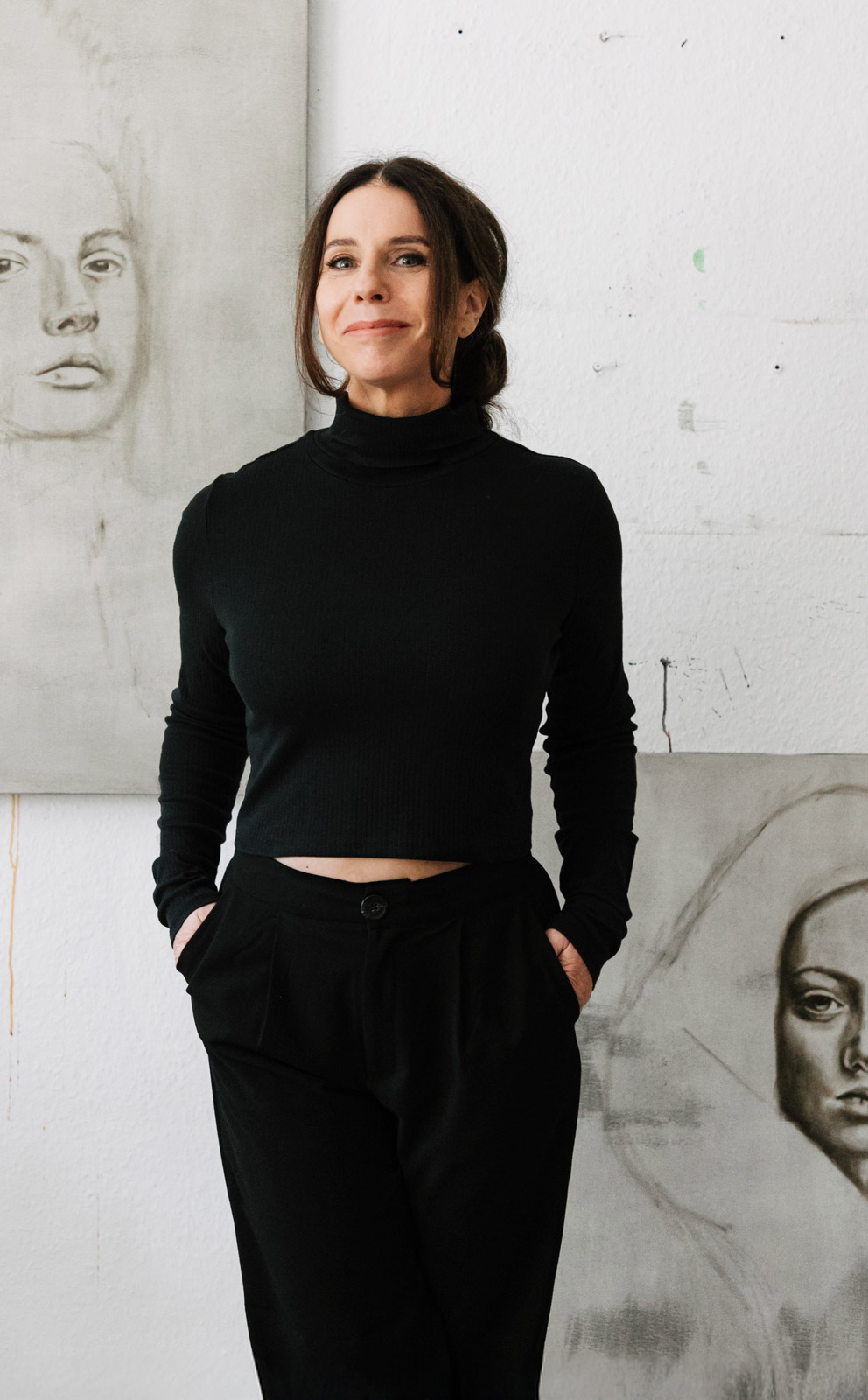
Romy Campe lives and works in Berlin.
2003 – 2006 studied painting and graphics at the IBKK in Bochum
2006 – 2007 masterclass with Andreas Christ
2008 – diploma in the field of painting and graphics
2006 – today Freelance artist
Member of the BBK – Professional Association of Visual Artists
EXHIBITIONS
Current
2027
History Re-coded
Galerie Feinart Berlin
Solo exhibition
April 10 – 24, 2027
ROMY. The Face of the Soul / ROMY. Il volto dell’anima
Museum Complex San Francesco, Trevi, Italy
Solo exhibition at Villa Fabbi, Museum Complex San Francesco, Trevi
Past
2025 PURE ROMY, Köppe Contemporary, Berlin
2023 AUGENBLICKE, Köppe Contemporary, Berlin
2022 NFT meets traditonal Art, Bermel von Luxburg Gallery, Berlin
2022 Art Karlsruhe, Bermel von Luxburg Gallery
2021 Bermel von Luxburg Gallery, Berlin
2021 TKB Art Center, Kaoshiung, Taiwan
2020 Galerie Rodin Art Space, Taipei, Taiwan
2019 ROMY – BEYOND NOW, Galerie Köppe Contemporary, Berlin
2019 Galerie KunstWerkberlin, Berlin
2018 Galerie Anna25, Berlin
2017 Kunstleben Berlin, Berlin
2016 PRIESTS AND PRAWNS, Willner Brauerei
2016 Romy Campe by Hagen/Eichner Collectors
2016 Gallery 66, New York
2015 Skylight Gallery, New York City
weitere Ausstellungen
2013 Forumfactory, Berlin: New York meets Berlin – reloaded
2013 ARThaus, Berlin: Lyrical Art Berlin
2013 Gallery 66, New York
2012 Gallery 66, New York
2012 Skylight Gallery, New York City
2012 KUNSTLEBEN BERLIN, Berlin: Künstler der Galerie
2012 KUNSTLEBEN BERLIN, Berlin: Black Label
2012 Skylight Gallery, New York City: under 30
2011 Skylight Gallery, New York City: gestalt – German Artists in Conversation
2011 KUNSTLEBEN BERLIN, Berlin: Romy Campe – New York
2010 aedium zeigt Bilder der Künstlerin Romy Campe, Berlin
2010 KUNSTLEBEN BERLIN, Berlin
2009 Babelsberger Kunstgalerie, Potsdam
2009 KUNSTLEBEN BERLIN, Berlin
2008 Kunst- und Galeriehaus, Bochum
2008 Kunst- und Galeriehaus, Bochum
2007 Kunst- und Galeriehaus, Bochum
2006 Schloß Mainberg, Schonungen
2005 Kunst- und Galeriehaus, Bochum
Selected Audio Interviews and Visual Media
Selected texts
THE FACE OF THE SOUL (2025)
Prof. Alberto D’Atanasio, Docente R.O. di Storia dell’Arte e Semiologia dei Linguaggi non Verbali, già incaricato per l’Estetica dei Linguaggi Visivi, Teoria della Percezione e Psicologia della Forma
Deutsche Version
DAS GESICHT DER SEELE
In ihren Gemälden offenbart und enthüllt sie Figuren, die sich durch eine feine, sensible Suche nach Linie, Zeichnung und Farbton ausdrücken. Sie wählt ihre Sujets nicht zufällig, und sie malt nicht aus dem Moment heraus – jedes Werk ist eine inspirierte Komposition. In ihrer künstlerischen Forschung verschmelzen Meditation und Kontemplation: Sie meditiert beim Komponieren des Werks, beim Wählen und Platzieren der Figur im Bildraum; sie kontempliert, wenn das Werk sie anschaut, wenn es das Dargestellte mit einem Licht durchstrahlt, das nicht von dieser Welt ist.
Zwei Begriffe sind wesentlich, um diese Künstlerin zu verstehen: Offenbarung und Enthüllung. Der erste gehört dem Objekt, das sich dem Betrachter zeigt, der zweite dem Blick des Schauenden auf das, was gesehen wird. So möchte ich das künstlerische Schaffen von Romy Campe einleiten.
Sie erschafft jenes Licht, das Leonardo da Vinci, Mantegna oder Caravaggio prägte. Dieses von ihr erfundene Licht ist wahre Offenbarung – es ist das Kennzeichen ihrer Kunst, das Wesen ihres Seins als Frau, Mädchen und immer noch staunendes Kind.
Diese Künstlerin ist wie eine Schamanin – sie hat sich über die Zeit eine Freiheit erarbeitet, die nur jemand kennt, der das Unendliche und das Transzendente zu spüren vermag. Romy ist ein Tor ins Anderswo.
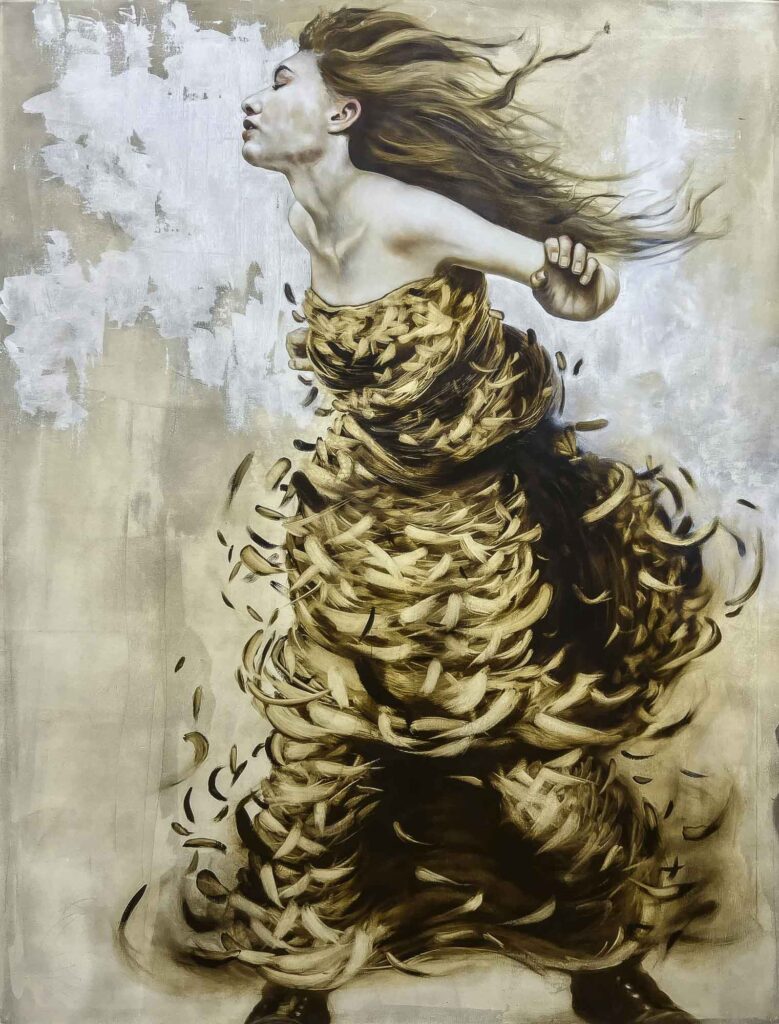
Sie malt wie im Ritus, als feierliche Handlung. Ihre Figuren erscheinen wie aus Licht modelliert, als wäre Materie bloß Hülle für etwas Transzendentes. Wie eine Künstlerin der Renaissance widmet sie jedem Detail größte Aufmerksamkeit. Nichts ist beiläufig, nichts ist bloß ein kreativer Einfall – alles ist Erzählung. Und in dieser Erzählung wird der Wind sichtbar, den ihre Malerei spürbar macht.
Ihre Bildwelt ist durchzogen von Symbolen und Figuren, die sich bewegen, obwohl sie stillstehen. In manchen Gemälden, mit einer Technik des „Wegnehmens“, erschafft sie ein monochromes Flirren – als hätte sie das Dargestellte durch Magie zum Stillstand gebracht, um es in seiner Anmut einzufangen. Der Betrachtende steht einem Moment gegenüber, der eingefangen wurde, um als Bild zur Erinnerung zu werden.
In den „Roms“, ihren hybriden Bildkörpern, erschafft sie Malerei-Collagen mit anthropomorpher Präsenz, die an den Hyperrealismus eines Salvador Dalí erinnern. Es ist, als würden Archetypen aus dem kollektiven Gedächtnis zu neuen Symbolen – sie schauen uns an und lassen sich anschauen.
Ihre Tonalitäten formen Ebenen, die Raum andeuten, ihn ordnen – wie in den Reliefs Donatellos, wo selbst die tiefste Fläche noch Gravur ist. So entsteht ein Kontinuum zwischen dem realen Raum des Betrachtenden und dem imaginären Raum des Bildes.
Für sie ist die Leinwand auch ein Symbol göttlicher Schöpfung: ein Ort, an dem mit dem „Ruach“ – dem Hauch – eine Gestalt zur Person wird, engelhaft, dem Schöpfer gleich. Davon ist sie zutiefst überzeugt. Wie Vincent van Gogh besitzt sie ein leidenschaftliches Temperament, kann sich tief berühren lassen und staunt wie ein ewiges Kind. Auch sie liebt Porträts – mit einer Zärtlichkeit, die an Märchen grenzt.
In jeder ihrer Figuren wird Natur zur Schwelle: Ihre Gestalten zeigen ihre Zugehörigkeit zum Schöpfer. Darum ist sie eine magische Frau. Eine Schamanin. Und manchmal malt sie barfuß – wie die Zauberinnen in John William Waterhouses Gemälde The Magic Circle von 1886.
Romy Campe besitzt eine akribische, meisterhafte Technik. Ihre Werke entstehen durch genaue Anordnung von Körpern im Raum, in Beziehung zu Farbe und Licht. Bei ihr erzeugt die Bildkomposition selbst das kontemplative Erlebnis. Das Licht wird zur geheimnisvollen Atmosphäre, die sich dem Betrachtenden öffnet.
Die Blicke ihrer Figuren tragen etwas Besonderes: eine Zeitlosigkeit, die seelische Bewegungen evoziert. Ihre Figuren sind nicht starr, sondern in einer anderen, parallelen Ebene verankert – gleich und doch anders als die des Betrachters. Sie erscheinen als Epiphanien einer erfassten und durchdachten Wahrheit.
Es ist beeindruckend, ihr beim Malen zuzusehen – es wirkt wie Tanz, wie ein Ritual. In ihrer Kunst lebt eine kathartische Kraft. Was Romy sucht, ist jenes alte Staunen, das sich im Akt der Mimesis zeigt: Materie und Natur sind dem Wandel unterworfen – aber die Kunst hält sie an, macht sie ewig, unsterblich, unendlich.
Romy Campe malt keine rätselhaften Figuren ohne Dialog – sie enthüllt das Mysterium der Materie, die den Funken der Unendlichkeit in sich trägt. Sie will genau das sichtbar machen, erfahrbar machen. Sie gibt dem Unendlichen eine Form – und der Seele ein Gesicht.
There are two key terms essential to understanding this artist: revelation and disclosure. The first belongs to the object as it presents itself to the viewer; the second comes from the gaze of the observer toward what is being seen. This is how I would like to introduce the artistic practice of Romy Campe.
In her paintings, she reveals and discloses figures that emerge through a refined exploration of line, drawing, and chromatic nuance. She does not choose her subjects randomly, nor does she paint impulsively—each work is an inspired composition. Her artistic process merges meditation and contemplation: she meditates while composing the work, choosing the subject and positioning it within the pictorial space; she contemplates when the work looks back at her, when it irradiates the subject with a light that is not of this world.
She creates that very light that once distinguished Leonardo da Vinci, Mantegna, and Caravaggio. The light she invents is true revelation—it defines her artistic signature, the essence of her being: woman, girl, and still a child, ever capable of wonder
This artist is like a shaman—over time she has gained the freedom of someone who can sense the infinite and the transcendent. Romy is a gateway to an elsewhere.
She paints as if in ritual, in a celebratory act. Her figures seem shaped from light, as though matter were only a vessel preserving something transcendent. Like a Renaissance painter, she attends meticulously to every detail. Nothing is accidental, nothing is the result of spontaneous creativity—everything is part of a narrative. And in that narrative, a wind becomes visible, made perceptible through her painting.
Her visual world is laced with symbols and figures—still, yet dynamic. In some works, using a subtractive technique, she creates a turbulence of monochrome tonalities, as if her magic had suspended the subject in time, capturing its enchantment. The viewer stands before a moment held in place, transformed into memory through the figurative image.
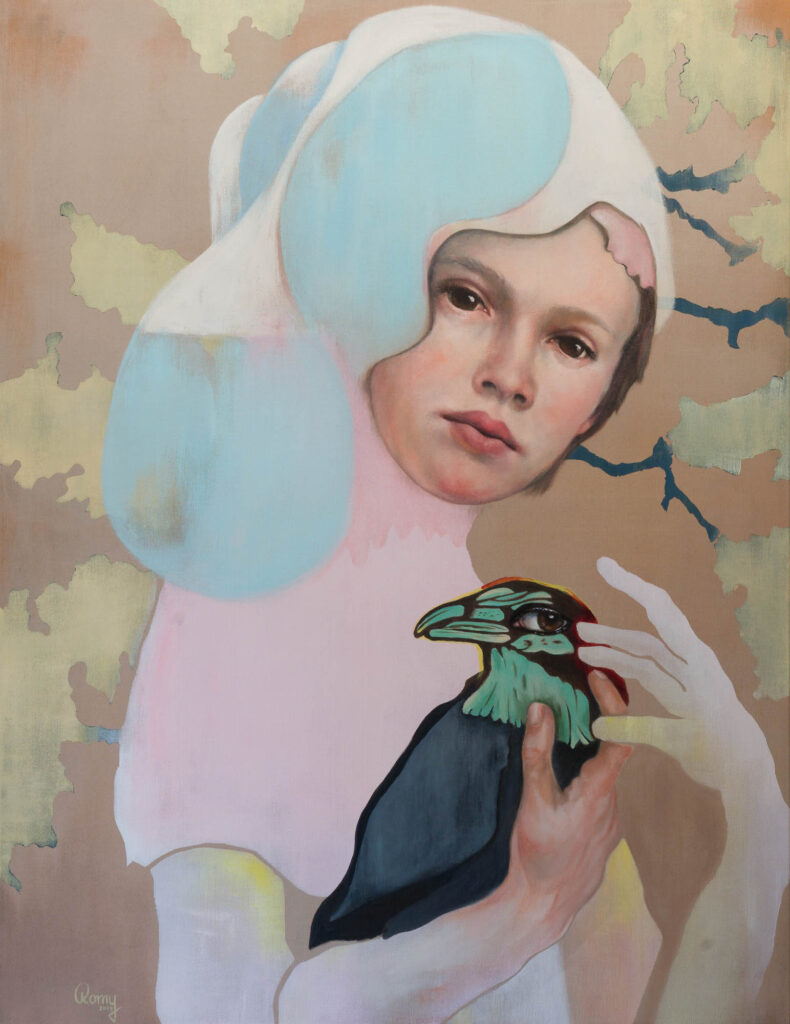
In her “Roms”—hybrid pictorial bodies—she invents collages with an anthropomorphic presence reminiscent of Salvador Dalí’s hyperrealism. It is as though archetypes from our collective memory have become new symbols, gazing at us and allowing themselves to be seen.
Her tonal planes create space and structure—like the reliefs of Donatello, where even the deepest background carries incision. Thus a continuum is formed between the empirical space of the observer and the imaginary space of the artwork.
To her, the canvas also becomes a symbol of divine creation: a space where, through the ruach—the breath—form becomes person, angelic, like the Creator. She is deeply conscious of this. Like Vincent van Gogh, she possesses a passionate temperament, capable of being deeply moved and enchanted like an eternal child. And like Van Gogh, she has an endless love for portraits that seem born of fable.
In each human figure, nature and matter become thresholds—her subjects reveal their belonging to the Creator. This is why she is a truly magical woman, a shaman in every sense. Fittingly, she sometimes paints barefoot, like the sorceresses in John William Waterhouse’s The Magic Circle (1886).
Romy Campe possesses a meticulous and masterful technique. Her works are constructed through a precise orchestration of forms in relation to color and light. In her art, the structure of the composition itself becomes the source of contemplation. Light becomes an atmosphere—mysterious and open to the viewer’s gaze.
The gazes of her figures bear something singular—a timelessness, evoking subtle movements of the soul. They are anchored in a different yet parallel realm—similar to, yet distinct from, that of the viewer. The human figure becomes, in her hands, an epiphany of a truth grasped and shaped by human cognition.
It is remarkable to watch her paint—she seems to dance, to perform a rite. Her artistic gesture carries the force of a cathartic act. What Romy seeks is that ancient wonder awakened by the exercise of mimesis: matter and nature are subject to the passage of time, and it is the artist who renders them eternal, immortal, infinite.
Romy Campe does not paint enigmatic subjects locked in silence—rather, she unveils the mystery of matter, which holds within it the spark of the infinite. She seeks to reveal and disclose all of this. Through her art, she gives form to the infinite—and a face to the soul.
Bildgewordene Empathie (2019)
André Lindhorst, Kurator Köppe Contemporary und ehemaliger Direktor der Osnabrücker Kunsthalle sowie der städtischen Galerie.
Die zentrale Rolle im Werk von Romy Campe spielt der Mensch. Die Bildnisse der Künstlerin spiegeln menschliche Wesensmerkmale wider – innere Zustände, Befindlichkeiten und Stimmungen. Das alles verweist – wenngleich die Motive auch Merkmale des Phantastischen und Surrealen aufweisen – auf die frühneuzeitliche Tradition des psychologischen Menschenbildes. So klingen vor manchen Motiven Assoziationen an Maltraditionen (Caravaggio, Franz Hals, Rembrandt) an.
Die Grisaille-Ölmaltechnik der Künstlerin steht ebenfalls im Zusammenhang mit altmeisterlichen Vorgehensweisen. Bis zu vierzig Lasurschichten legt sie im Malprozess übereinander. Dass ROMY in die altmeisterliche Ausdrucksform surreale und phantastische Dimensionen mischt, verleiht ihren Kompositionen jedoch eine besonders eigenwillige und individuelle Note.
Was sie malt sind Vorstellungswelten im Grenzbereich zwischen Wirklichkeit und Traum, wahrhaftem Abbild und skurriler Schöpfung. Ein spezifischer Ausdruck der Augen, sowie die Gebärden und Gesten der Menschen, die sie ins Bild setzt, deuten auf innere Verfasstheiten hin. Solche Motive spiegeln Lebensgefühle und Empfindungen wider – Sehnsüchte, Erwartungen, Hoffnungen oder Zuversicht, aber auch Angst, Wut oder Verzweiflung.
Oft ausgehend vom eigenen Selbstbild durchspielt die Künstlerin ihre Motive. Neben der Darstellung moderner, meist junger Frauen aus dem realen Alltag, bevölkern phantastische Figuren, Misch- oder Fabelwesen oder auch mythologische Geschöpfe ihr Œuvre. Symbiosen und Transformationen sind omnipräsent.
Ein dominanter Aspekt vieler Werke von ROMY ist der oft in gedämpften Farben gehaltene, zumeist tiefdunkle Hintergrund, vor dem ihre Figurationen agieren. Er ist verbunden mit dem Effekt des ‚Sfumato‘ (des Verschwommenen oder Unbestimmten). Dieses Stilisieren oder Ausblenden eines konkret fassbaren Raumes unterstreicht den Eindruck einer Imagination bzw. einer phantastischen Zwischenzone, in der nicht mehr zwischen Realität und Traum und auch nicht mehr zwischen heute, gestern oder morgen unterschieden werden kann.
„Meine Bilder zeigen Visionen der menschlichen Existenz und umfassen Bereiche der Vorstellungskraft, des Begehrens, des Träumens und des Entfliehens aus dem Jetzt“, erläuterte ROMY ihre Werke einmal in einem Interview. Trotz der traumhaften Zweideutigkeit, in die die Künstlerin viele ihrer Motive „einbettet“, wecken ihre Bilder durchaus auch Assoziationen an unsere moderne Gegenwart und an die mit ihr verbundenen verunsichern den Erfahrungen.
So sind Themen wie Melancholie oder auch die Suche nach einer eigenen Identität in den Motiven der Künstlerin ebenso präsent wie das Widerständische. Der Widder wird in ROMYs Bildern zur mythischen Symbolgestalt. Mit seinen gekrümmten Hörnern, seiner Kraft und seinem Mut steht er für das Durchsetzungsvermögen und für den Widerstand gegen alles, was ihn bedrängt.
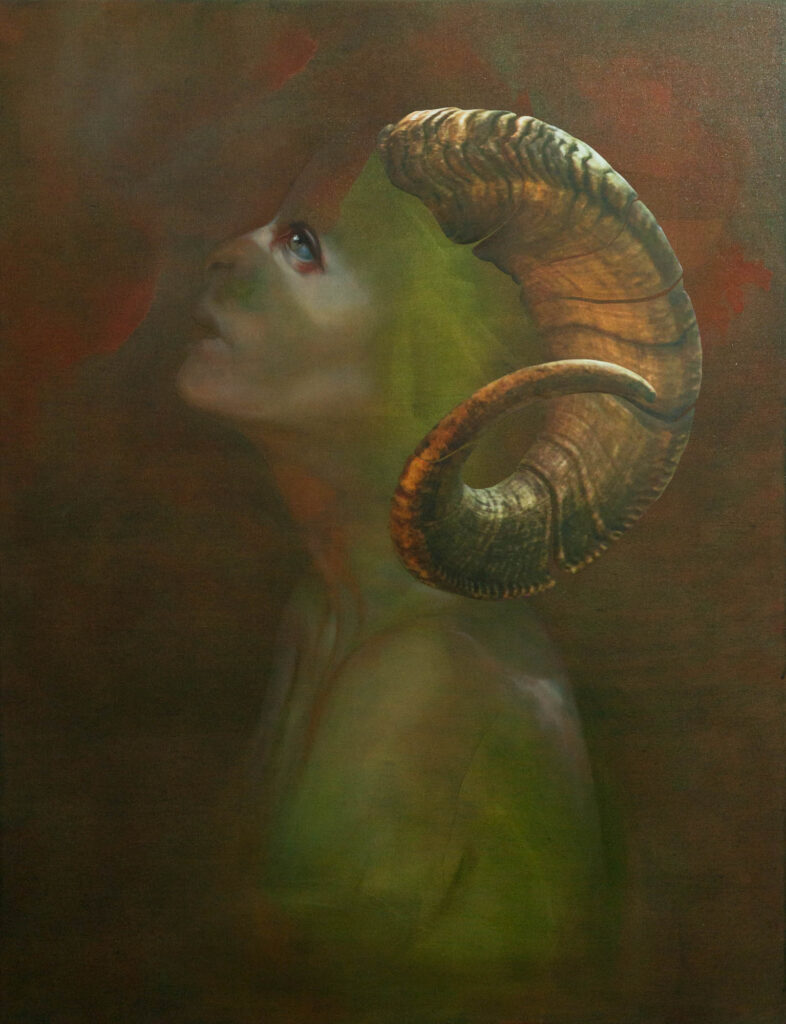
Einen besonderen Stellenwert nehmen Collagen im Œuvre der Künstlerin ein. Zum einen handelt es sich um Arbeiten, in denen ROMY Malerei mit Fotografie kombiniert. Zum anderen
sind es Motive, die aus der Symbiose von Malerei und Fotografie sowie aus einem experimentellen Arbeitsprozess am Computer (beispielsweise auf der Grundlage fotografischer Selbstbildnisse der Künstlerin) hervorgehen. Die Ergebnisse eines solchen Arbeits prozesses bezeichnet ROMY als „Morphings“.
In diesen Morphings ist nicht nur dem Zufall breiter Raum gegeben, sondern hier geht die Künstlerin – beispielsweise mit der „Zerstörung“ ihres eigen (fotografischen) Selbstbildnisses – auch einen Schritt über sich selbst hinaus. In ihrer Hybridität wirken diese Bilder einerseits rätselhaft oder verstörend, andererseits irritieren sie aber auch die uns ständig umgebenden Motive schöner Posen in der Werbung oder in den Massenmedien, und entlarven diese als Manipulation und Täuschung.
Das Bildnis des Menschen ist mehr denn je fragwürdig und unberechenbar geworden. Dieses Motiv ist ein roter Faden, der sich durch das Werk der Künstlerin ROMY zieht. Denn das Märchenhaft-fantasievolle, das Groteske und Bizarre kontrastiert auf eine hintergründige Weise mit dem Zwielichtigen, Unergründlichen und Unheimlichen. Text: André Lindhorst